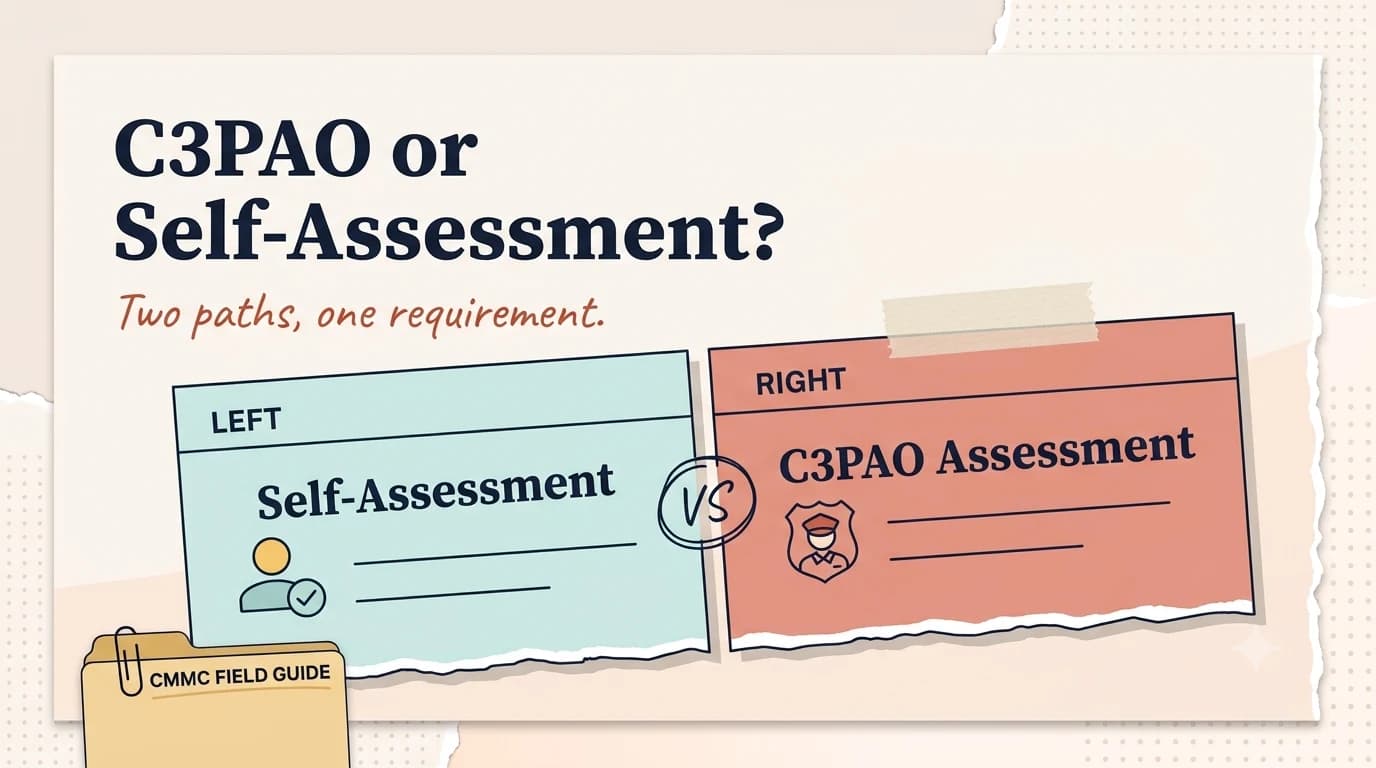
When each path is applicable, Level 2 Self and Level 2 C3PAO evaluate the same Level 2 NIST SP 800-171 Rev. 2 requirement set, but they produce different assessment processes and contracting outcomes. One is performed by the organization; the other is performed by an authorized CMMC Third-Party Assessment Organization. The controlling label for a bid is the one required by the solicitation and current implementation posture—not the shorthand used in a vendor quote or an old rollout chart.
The July 2026 suspension changes the immediate buying decision. The Department says Phase II is suspended, and the current program page says Phase 1 may only require Level 1 Self and Level 2 Self during this period. The regulatory text still contains a Level 2 C3PAO designation, but a business that budgeted for certification because of the former rollout calendar should re-check the current procurement trigger before spending.
The difference begins in the solicitation
DFARS 252.204-7025 contains Level 2 (Self) and Level 2 (C3PAO) designations in the regulatory text, but the implementation phase still matters. As of August 2026, Phase II is suspended and the current program page says Phase 1 may only require self-assessments at Level 1 and Level 2. Copy the solicitation field into the bid checklist and confirm any apparent C3PAO requirement through the procurement channel before the company books an assessment.
Do not make the decision from the sensitivity of the project name alone. The contracting activity determines the CMMC requirement in the solicitation. Your job as the offeror is to understand the information involved, know which system will handle it, and present the status and identifiers required for that system.
Who performs the assessment and where the record goes
In a Level 2 Self path, the organization evaluates its own implementation and follows the government process for recording the result and affirmation. In the C3PAO path, an authorized third-party assessment organization conducts the certification assessment under the CMMC ecosystem. That external process introduces scheduling, assessor availability, evidence coordination, and cost that a self-assessment does not.
The administrative trail differs as well. Current program materials describe C3PAO assessment results entering the CMMC eMASS process, while the contractor still has SPRS-related affirmation responsibilities. For small teams, that means the compliance register should distinguish the assessment event, the resulting CMMC status, the affirmation, and the system UID rather than treating them as one checkbox.
The technical preparation should still look assessor-ready
A self-assessment is not a reason to lower evidence quality. Scope the environment using the same disciplined asset categories, keep the SSP synchronized with the real architecture, and make each requirement traceable to evidence. If a control is supported only by tribal knowledge, a future C3PAO assessment will expose the gap even if today's self-assessment accepted it informally.
A useful internal standard is 'another competent person can reproduce the answer.' For a sampled requirement, that person should be able to locate the implementation statement, identify the system component, retrieve the latest artifact, and explain why the evidence supports MET or NOT MET without asking the original implementer to translate it.
Budget after validating the business trigger
Third-party assessment can be a significant project for a small contractor, so tie the expense to an actual business need. Look at the opportunities you intend to pursue, their likely award dates, the current CMMC phase, and the systems in scope. A generic fear that 'everyone will need certification soon' is not a budgeting model.
That does not mean waiting until a solicitation drops. Long-lead remediation, enclave design, provider contracts, evidence organization, and internal mock assessments can begin earlier because they improve readiness across both paths. Separate the investment that reduces security and evidence gaps from the fee and logistics of a specific certification event.
Conditional status and closeout still require discipline
The underlying CMMC rule defines conditional-status mechanics for both Level 2 Self and Level 2 C3PAO paths when qualifying POA&M items are allowed. The current 2026 Phase 1 posture is narrower and may only require self-assessment, but the rule structure still matters when reading older plans or preparing for later changes. Conditional is not final: track the status date, eligible findings, remediation owners, and closeout evidence from day one.
The closeout method follows the assessment path defined by the rule. Level 2 Self closeout is performed through the self-assessment route; a Level 2 C3PAO closeout belongs to the certification-assessment route. Keeping those mechanics distinct is useful even during the Phase I pause because it prevents future planning documents from collapsing every Level 2 event into one generic 'assessment.'
Decision table for a small contractor
Use three questions before committing to either path: What does the solicitation require? Which system will perform the work? What current status already exists for that system? If the answer to the first question is not yet known, keep the environment assessor-ready but avoid claiming a required certification event that has not been established.
When an opportunity becomes concrete, add timing. Compare proposal due date, anticipated award, assessment validity, annual affirmation, and any conditional closeout date. That timeline tells leadership whether the risk is technical remediation, assessor scheduling, record currency, or simply a missing internal mapping between the opportunity and an already-qualified system.
Two companies with the same controls can face different projects
Consider two companies with nearly identical CUI enclaves. Company A is working under the current Phase I self-assessment posture. Company B is using the underlying C3PAO path as a future-readiness scenario because a customer program is expected to require certification after implementation changes again. Technically, both benefit from disciplined Level 2 implementation, but only the second project should carry assessor scheduling and certification logistics—and only when a real procurement or program trigger supports that spend.
Company A can focus its immediate schedule on internal assessment quality, SPRS submission, affirmation, and evidence maintenance. Company B must add assessor selection, contract terms, assessment scheduling, evidence logistics, interview availability, and closeout coordination. Those are meaningful operational differences even when the underlying security controls look similar.
What the assessment path changes for the business
If Phase II timing changes again, Company A's active solicitation may remain unchanged while Company B's future pipeline may shift. This is why program phase and procurement requirement should live as separate fields in the readiness register. One describes the broader rollout; the other controls the specific bid.
A strong organization prepares the environment once and varies the assessment logistics, not the integrity of the controls. The self-assessment path should not become a low-evidence shortcut, and the C3PAO path should not be treated as a one-time performance staged only for the assessor.
If the pipeline is uncertain, treat assessor scheduling as a procurement decision rather than a badge purchase. Ask which opportunity requires the C3PAO path, when award is realistically expected, whether the assessment scope matches the system proposed for that work, and what happens if the opportunity slips. A reserved assessment window can be valuable, but only when it is attached to a business reason. This keeps the compliance budget tied to actual contract demand instead of to general anxiety about CMMC.
A short working check
- ✓Locate the CMMC level in the solicitation
- ✓Determine Self versus C3PAO requirement
- ✓Check the current rollout status
- ✓Match the assessment to the exact system boundary
Common questions
Does the Phase II suspension delete Level 2 C3PAO from the rules?
No. The suspension changes implementation timing; the contracting framework still distinguishes assessment types.
Should a small business get a C3PAO assessment early?
Only after considering actual contract requirements, program timing, customer demand, scope readiness, and cost. An unnecessary early assessment can be expensive.
Are the Level 2 security requirements different for Self and C3PAO?
The Level 2 requirement set is the same; the assessment path and who performs the assessment differ.
Official sources used for this guide
Open the primary source before making a contract-specific decision. Regulations and program implementation can change.